
INNOSPACE set the launch window from December 14 to December 21 (Brasilia Time, BRT) as the first rocket engine test flight of the HANBIT-TLV suborbital vehicle for the development of its own small sa
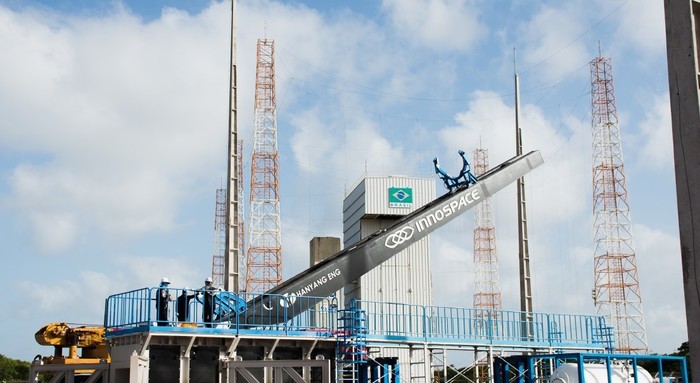
SEJONG, South Korea (December 9, 2022) – INNOSPACE, a South Korean private spaceflight startup for small satellite launch vehicles, set the launch window from December 14 to December 21 (Brasilia Time, BRT) as the first rocket engine test flight of the HANBIT-TLV suborbital vehicle for the development of its own small satellite launch vehicle.
In cooperation with the Brazilian Air Force and the Brazilian Department of Aerospace Science and Technology (“DCTA”), the final launch date and time within the launch window will be decided in consideration of weather conditions at the Alcântara Launch Center in Brazil.
INNOSPACE is developing a series of HANBIT small satellite launch vehicle. The HANBIT-TLV, a suborbital test launch vehicle, is to validate the first stage engine of HANBIT-Nano, which is a 2-stage small satellite launcher capable of carrying a 50kg payload. HANBIT-TLV is a 15-ton thrust single stage hybrid rocket with a height of 16.3m, 1-meter-diameter, and weight of 8.4-ton.
In addition, in accordance with the agreement signed with DCTA on April, the HANBIT-TLV will carry onboard the payload SISNAV, an inertial navigation system being developed by DCTA and other institutions despite a test flight. SISNAV has weight of 20kg and 310 × 400 × 280 mm3 in size.
“This test flight of HANBIT-TLV suborbital rocket will serve as an important step to enter the small satellite launch service market. So, we will try to successfully launch HANBIT-TLV, a suborbital rocket powered by hybrid rocket engine developed with our own technology over the past five years,” said Soo Jong Kim, CEO of INNOSPACE.
INNOSPACE will verify the flight performance focusing on the optimal operation and stable thrust of the hybrid rocket engine, and the success of the engine verification will be finally confirmed based on the results of a comprehensive analysis of engine and flight data obtained after launch.


 PREVIOUS