
INNOSPACE announced that it had successfully completed the fairing separation test, a key technical milestone in the development of its first commercial launch vehicle, the ‘HANBIT-Nano’, which is als
INNOSPAACE (KS: 462350), a South Korean commercial satellite launch vehicle, announced that it had successfully completed the fairing separation test, a key technical milestone in the development of its first commercial launch vehicle, the ‘HANBIT-Nano’, which is also its first orbital launch vehicle. The test was conducted at INNOSPACE’s Cheongju facility (located in Gangnae-myeon, Heungdeok-gu), where the development model was unveiled.
By successfully completing the fairing separation test, which is regarded as the final hurdle to safely placing a satellite into orbit, INNOSPACE has overcome an important technical phase in the launch vehicle development process. This test not only verified the stable protection of payloads and the correct separation of the fairing at the designed timing, but also demonstrated the reliable development and technological credibility of the launch vehicle to actual customers. The success of this test, based on technology transferred from Korean research institutes, underscores INNOSPACE's technical capabilities and the fruits of its collaborative research efforts.
The fairing acts as a cover to protect the satellite and other payloads on the launch vehicle from external environmental factors such as air resistance, vibration, heat, sound waves, and pressure during launch. Since the primary mission of launch vehicle companies is to safely deliver customer satellites into orbit, the reliability of the fairing separation technology is critical for the flight safety of the launch vehicle, the protection of the payloads, and the overall success of the customer’s mission.
INNOSPACE is fully committed to the development of its two-stage small satellite launch vehicle, ‘HANBIT-Nano’, which aims for its first launch in March 2025. The vehicle is 21.8 meters in length, with a diameter of 1.4 meters and a maximum payload capacity of 90 kg. Of this, the fairing measures 2.6 meters in height and 1.4 meters in diameter.
The fairing developed by INNOSPACE has been specially designed to maximize lightweight and durability. Instead of traditional metal structures, the fairing is made using a carbon composite layered structure to reduce weight. To ensure heat resistance under high temperatures, a special high-temperature coating material was applied. In addition, to achieve stable and precise separation, the fairing utilizes a ‘split-nut mechanism’ as the separation device. This mechanism is simpler than pyrotechnic separation systems, contributing to weight reduction and minimizing impact during the separation process, reducing the risk of damage to the launch vehicle and payload.
Through the recent fairing separation test, INNOSPACE validated the responsiveness of the separation device and the functionality of the spring assembly structure. By analyzing high-speed footage captured during the test, it also quantified the separation speed and confirmed the accuracy of the separation mechanism. In the next phase of development, INNOSPACE plans to apply a separation device made from shape memory alloy, a special material that is lightweight and remains stable even in high-temperature environments. This latest technology aims to further minimize the shock transmitted to the satellite during fairing separation. These advancements are expected to play a critical role in enhancing the reliability and stability of the launch vehicle.
“The success of this fairing separation test allows us to demonstrate to customers that we are executing the scheduled timeline and key technical milestones for the development of our first commercial launch vehicle, ‘HANBIT-Nano’. As a private space launch company, INNOSPACE will continue its efforts to develop competitive launch vehicles, providing stable transportation solutions whenever global public, private, and military sectors seek to utilize space. We aim to continuously generate business success based on this foundation,” said Soojong Kim, CEO and founder of INNOSPACE.
The ‘HANBIT-Nano’ is a two-stage space launch vehicle capable of carrying a 90kg payload to a 500km Sun-Synchronous Orbit (SSO). The launch vehicle consists of a 25-ton thrust hybrid engine in the first stage and a 3-ton thrust engine in the second stage. Depending on the customer’s mission requirements, the second stage can operate either the hybrid engine ‘HyPER’ or the methane engine ‘LiMER’, allowing INNOSPACE to offer tailored launch services.
‘HANBIT-Nano’ is currently under development, with its first launch scheduled for March 2025 at the Alcântara Space Center in Brazil. The payload fairing will carry satellites and payloads from various customers, including the Federal University of Maranhão (UFMA) and Castro Leite Consultoria LTDA (CLC), with whom INNOSPACE signed a launch service contract in April.
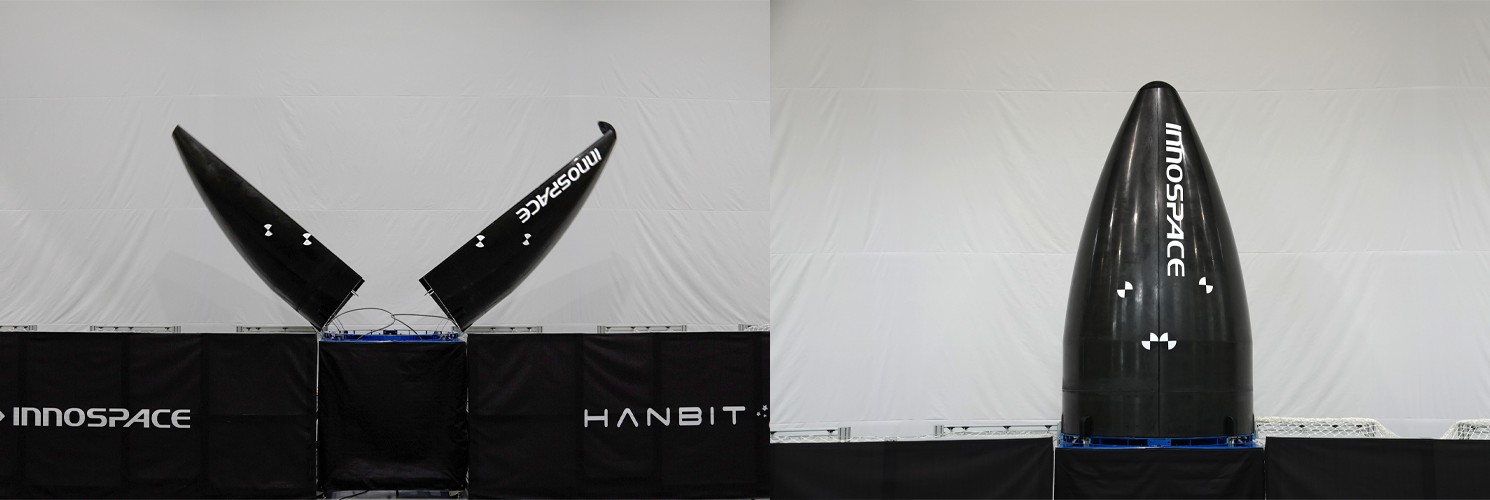
▲The moment of fairing separation for INNOSPACE’s first satellite launch vehicle, ‘HANBIT-Nano’
▲INNOSPACE unveils the development Model of the fairing of its first satellite launch vehicle, ‘HANBIT-Nano’


 PREVIOUS