
INNOSPACE announced that it has successfully conducted a stage separation test to verify the separation of the first and second stages of its first satellite launch vehicle, HANBIT-Nano, at its Cheong
● Securing all core technologies through Seamless progress in launch vehicle development
● Completion of stage separation technology, critical for stable second-stage spaceflight and precise satellite orbit deployment
SEJONG, South Korea (December 23, 2024) – INNOSPACE (KS: 462350), a South Korean commercial satellite launch vehicle company, announced that it has successfully conducted a stage separation test to verify the separation of the first and second stages of its first satellite launch vehicle, HANBIT-Nano, at its Cheongju facility in South Korea.
The stage separation test simulates and verifies the process of separating the first and second stages of the launch vehicle. It confirms whether the separation mechanism operates precisely as designed. Through this test, INNOSPACE achieved its target data by verifying the accuracy of the separation timing and the precision of the structural detachment location, completing the technical validation.
With the successful completion of the stage separation test, following the payload fairing separation test, INNOSPACE has secured all the core technological components for the HANBIT-Nano launch vehicle. This achievement is based on technology transferred from domestic research institutes and reflects the technological capability and collaborative efforts of INNOSPACE.
Stage separation technology plays a crucial role in enabling the second stage of the launch vehicle to continue its stable flight in space and to precisely deploy the satellites into its designated orbit. Since launch vehicles carry sensitive electronic equipment and instruments, minimizing the shock generated during the separation process is essential.
For this stage separation, INNOSPACE employed its split-nut mechanism, used for the payload fairing separation device. This mechanism offers advantages over pyrotechnic separation nuts method, which requires additional structures for storing and using explosives. The split-nut mechanism is simpler, making it advantageous for weight reduction. Specifically, it uses pressurization and screw rotation-based physical principles instead of explosive methods, minimizing shock to the launch vehicle and payload during separation and preventing damage.
“With the successful stage separation test, we have secured and validated all the necessary technical components for HANBIT-Nano, significantly enhancing the reliability and technical completeness of the launch vehicle. Over the remaining period until the first launch scheduled for July next year, we will continue to stabilize the technology and ensure the seamless completion of final assembly and stage qualification tests,” said Soojong Kim, founder and CEO of INNOSPACE.
The ‘HANBIT-Nano’ is a two-stage space launch vehicle capable of carrying a 90kg payload to a 500km Sun-Synchronous Orbit (SSO). The launch vehicle consists of a 25-ton thrust hybrid engine in the first stage and a 3-ton thrust engine in the second stage. Depending on the customer’s mission requirements, the second stage can operate either the hybrid engine ‘HyPER’ or the methane engine ‘LiMER’, allowing INNOSPACE to offer tailored launch services.
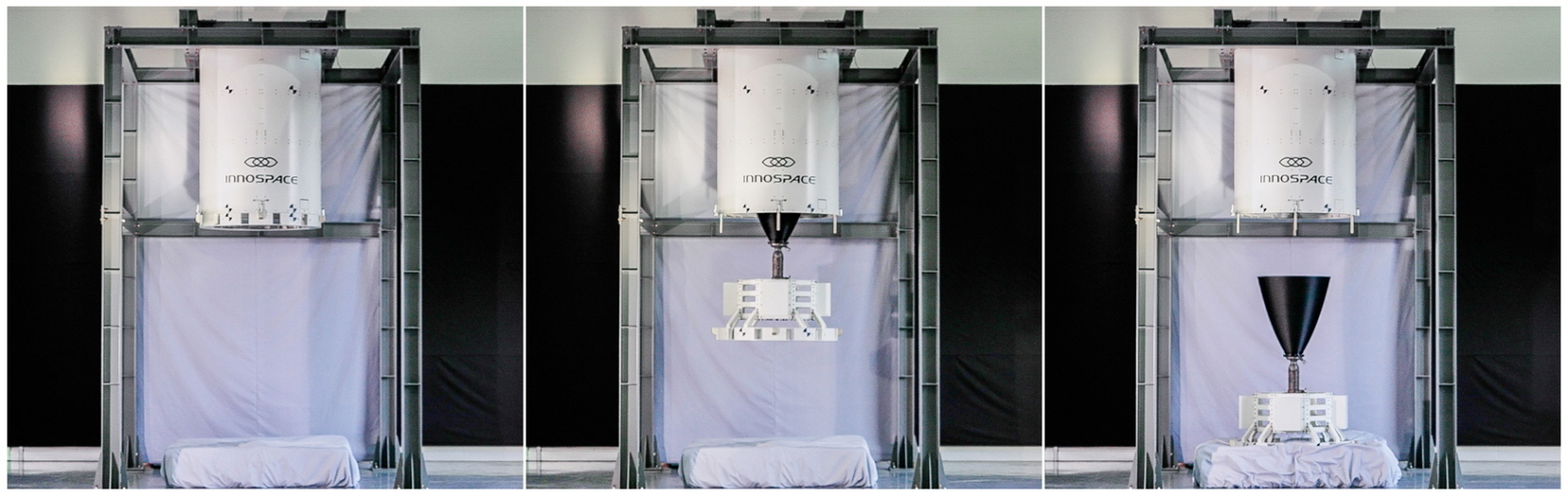 ▲ A sequence showing the separation of the first stage (top) and second stage (bottom) of the HANBIT-Nano (Video Snapshot)


 PREVIOUS